
The Common App tells you one thing. Your college counselor suggests another. Online forums are split. Meanwhile, you’re sitting there wondering if 550 words is “good enough” or if you’re shooting yourself in the foot by not pushing closer to 650.
Here’s what you need to understand: word count isn’t just a technical requirement. It’s a strategic advantage or a silent disadvantage, depending on how you approach it.
This guide breaks down the exact word count requirements, reveals what admissions officers actually think about length, and gives you a framework for allocating your words strategically so every sentence earns its place.
The Official Common App Essay Word Count Requirements
Let’s start with facts, because confusion often starts here.
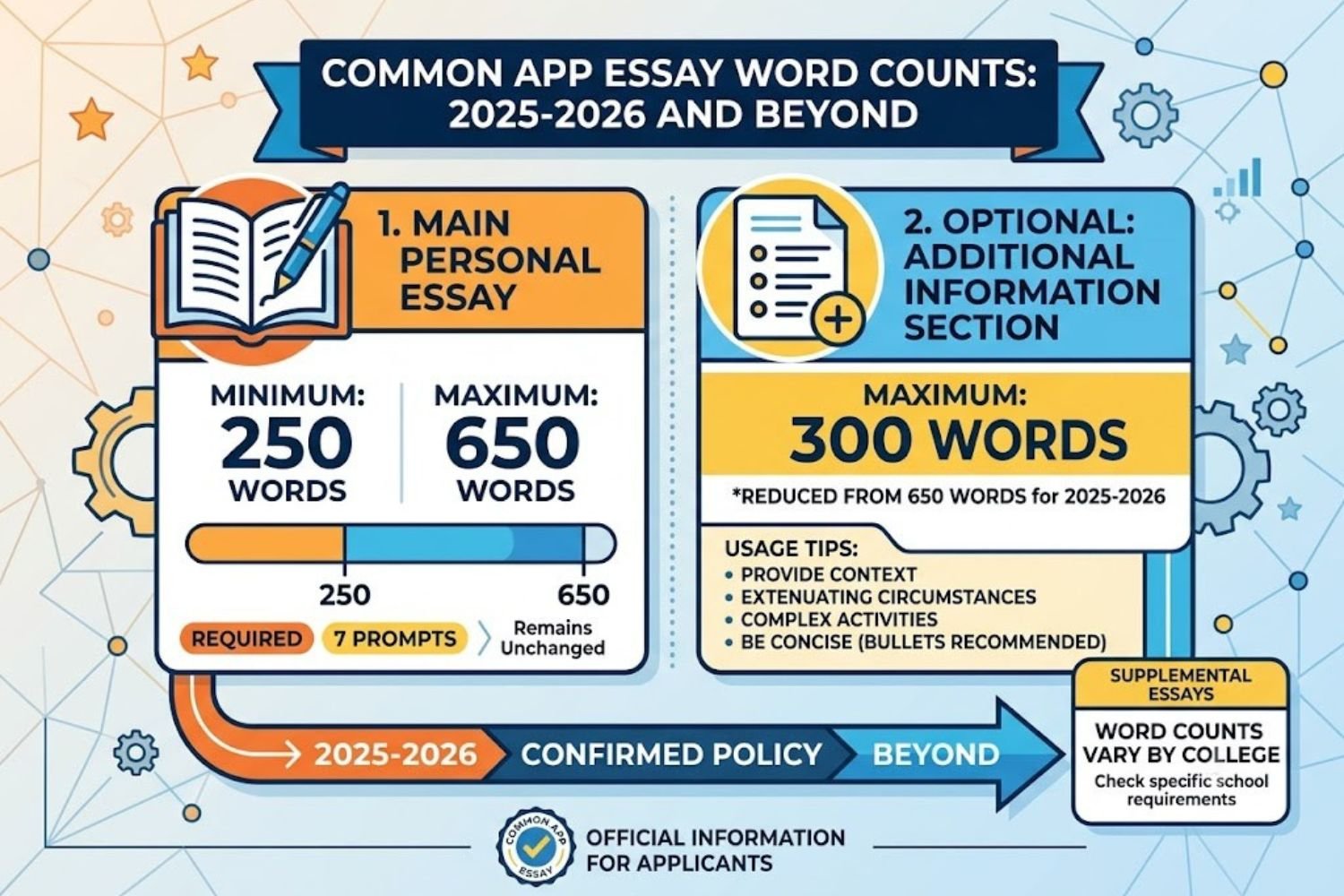
The 650-Word Maximum
For the 2025–26 and 2026–27 application cycles, the Common App essay has a hard maximum of 650 words. This limit has been consistent since 2015. It’s not changing. It’s not flexible.
The Common App platform will cut off anything exceeding 650 words, meaning if you paste a 670-word essay, readers will see it end mid-sentence. This isn’t a suggestion; it’s a hard technical boundary.
The 250-Word Minimum
Your essay must be at least 250 words to be submitted. Essays below this threshold won’t go through the system. This gives you a defined range: 250–650 words.
But understanding the range and understanding what works strategically are two different things.
What Counts Toward Your Word Count
Here’s where precision matters: The Common App word counter measures strings of characters separated by spaces. Only the essay body counts—the prompt itself and any title you add do not factor into your word total.
Hyphenated words count as a single word. For example, “self-reflection” counts as one word, not two.
Formatting, spacing, and line breaks don’t count. Only words.
Why Word Count Matters More Than You Think
This is where most students get it wrong.
You’ve probably heard someone say: “Quality always beats quantity. Write a tight 450-word essay and forget the rest.”
There’s a kernel of truth in that. But taking it too far is a strategic mistake.
What Admissions Officers Notice
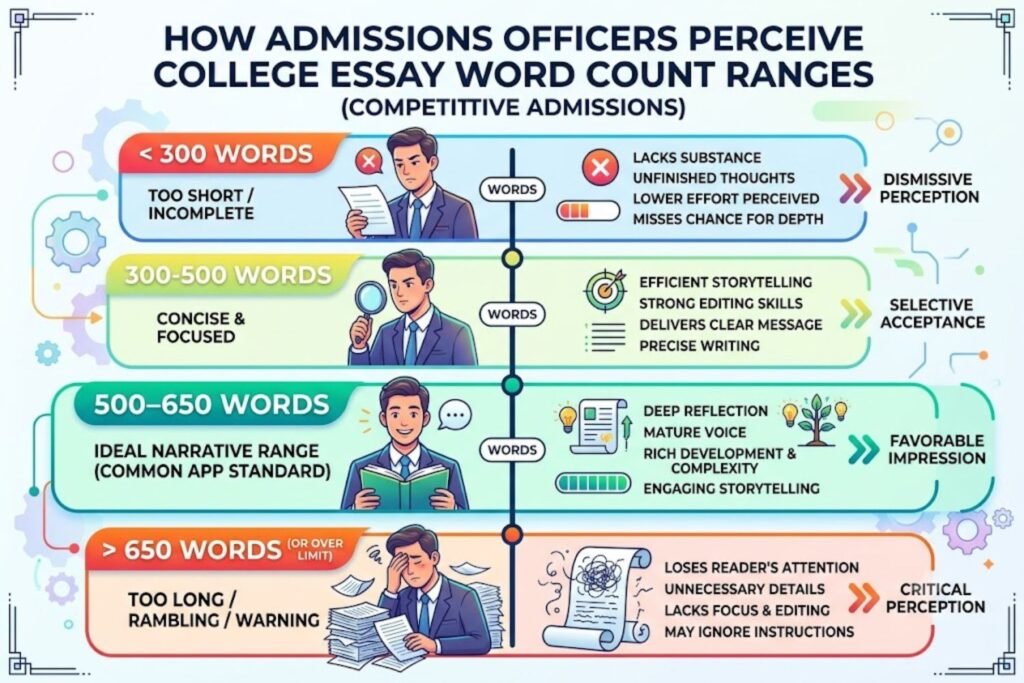
Admissions officers read thousands of essays every season. They’re looking for essays that demonstrate full engagement with the prompt, which most successful essays show by landing in the 600–650 range.
When an officer sees an essay at 450 words, they notice. Not consciously at first, but they notice.
An essay that lands at 580 or lower leaves room you didn’t use, and admissions officers notice that. By contrast, hitting 620 or higher signals that you took the assignment seriously and had enough meaningful material to say to fill the space.
The Psychology Behind Length
Think about what word count signals:
- 600-650 words: “I invested real time. I have depth to share. I didn’t rush.”
- 450-500 words: “I said what I needed to say and stopped.” (Which might be true, but feels thin given 650 words are available.)
- 250-300 words: “I did the minimum.”
Taking a meaningful life experience—something with real depth—and compressing it into 450 words sends a message that admissions officers read clearly: you either didn’t have enough to write about yourself, or you didn’t push yourself to dig deeper.
What Undershooting Signals
This isn’t about padding. It’s about what inadequate length communicates:
- Limited self-reflection
- Insufficient storytelling detail
- Possibly, disengagement with the task itself
- In competitive admissions, it looks like you didn’t treat this seriously
You have 650 words. Why aren’t you using them?
The Strategic Word Count Range: 620–650 vs. 500–600
You’ll find conflicting advice online. Some sources say aim for 500 words. Others say 600-650. Let’s clarify.
Why 620–650 is the Real Target
The sweet spot for the Common App essay is 620–650 words. That’s the real target—not exactly 650, and not anywhere below 600.
This range represents:
- Sufficient depth without artificial padding
- Full engagement with the prompt
- Room for meaningful detail, storytelling, and reflection
- A signal to admissions officers that you took the assignment seriously
Landing below 600 words, even at 580 or 590, leaves available space unused, which admissions officers notice and interpret as underutilization of the opportunity.
Why Some Advise 500 Words (And Why They’re Missing the Point)
You’ll encounter sources—even some from admissions consultants—recommending 500 words as the “sweet spot.”
Some research indicates that effective essays tend to fall between 500-600 words, based on surveys of admissions officers.
Here’s the nuance: a truly exceptional 500-word essay can outperform a mediocre 650-word essay. That’s always true. Quality trumps length.
But in competitive admissions, you’re not up against “average” essays. You’re competing against students who wrote compelling 640-word essays. At that point, a 500-word essay isn’t maximizing your advantage.
The Data-Backed Approach
Admissions experts commonly cite 500 words as a typical length, though some experts describe 500 as the “sweet spot,” acknowledging that essays closer to 430 or 620 words can also perform well if you’re genuinely proud of the content.
Translation: 500 is acceptable. 620-650 is optimal.
The difference matters in competitive admissions.
Allocating Your Word Count Strategically
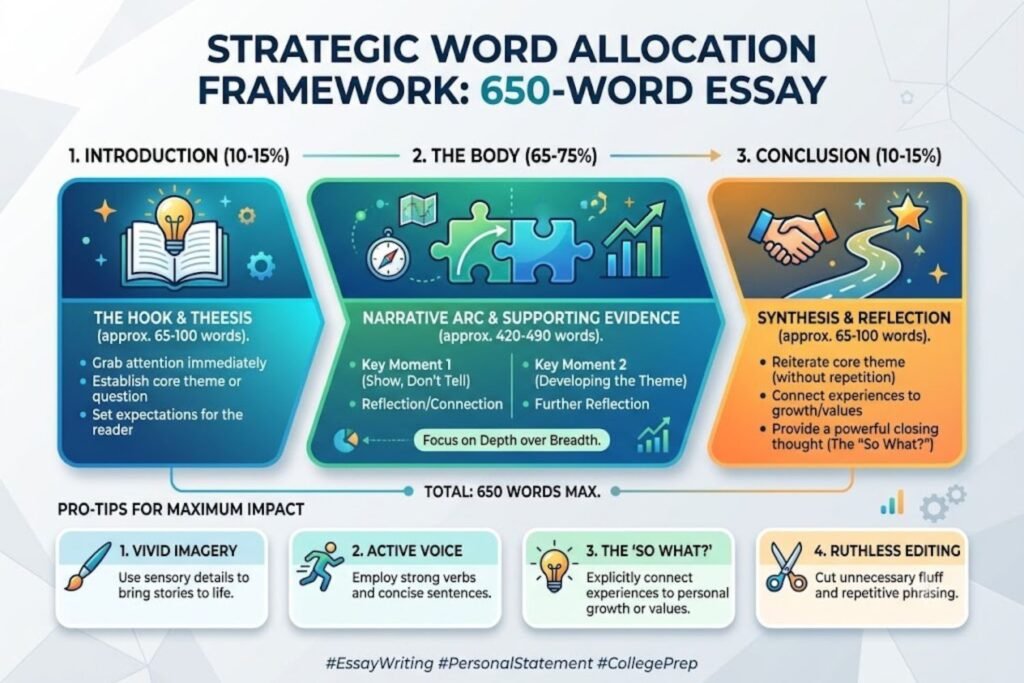
Here’s where strategy actually begins. You don’t just aim for 650 words and hope. You allocate them purposefully.
Think of your essay as having four sections, each serving a specific function:
Opening (100–150 Words)
Your opening does critical work:
- Hooks the reader
- Establishes your voice
- Introduces the core experience or realization
- Sets context without over-explaining
Don’t waste opening words on preamble. Dive into your story or reflection immediately. Show, don’t announce.
Example of effective opening:
“I was halfway through explaining photosynthesis to a classroom of eighth graders when I realized I was the least qualified person in the room. Marcus had his hand up—he always did—not with a question, but to correct my explanation. He was right. That moment changed how I understood teaching, competence, and what I actually wanted to do with my life.”
That’s roughly 60 words and immediately orients the reader to a specific moment that matters.
Development & Storytelling (200–250 Words)
This is your narrative core. Use these words to:
- Unfold your story with concrete details
- Show character through action and dialogue
- Build tension or complexity
- Introduce obstacles or meaningful challenges
This section should be rich with specifics—not “I worked hard” but “I spent three months developing a lesson plan, failing, and redesigning it.”
Concrete details don’t just fill space; they make your essay memorable and credible.
Reflection & Insight (200–250 Words)
This is where admissions officers learn who you actually are. Use these words to:
- Explain what you learned about yourself
- Articulate how this experience shifted your thinking
- Connect specific moments to deeper realizations
- Show intellectual maturity and self-awareness
Don’t just describe what happened. Explain why it mattered. What did you realize about yourself, others, or the world? How did you change?
Admissions officers read this section closely. It’s where you demonstrate that you don’t just have experiences—you learn from them.
Resolution & Closure (50–100 Words)
Conclude by:
- Connecting your insight to your future (briefly)
- Reaffirming the significance of what you learned
- Finishing with a strong final image or thought
- Avoiding cliché or forced wisdom
Strong closings are brief. They don’t restate everything. They land.
Common Mistakes With Word Count
Underwriting Your Essay
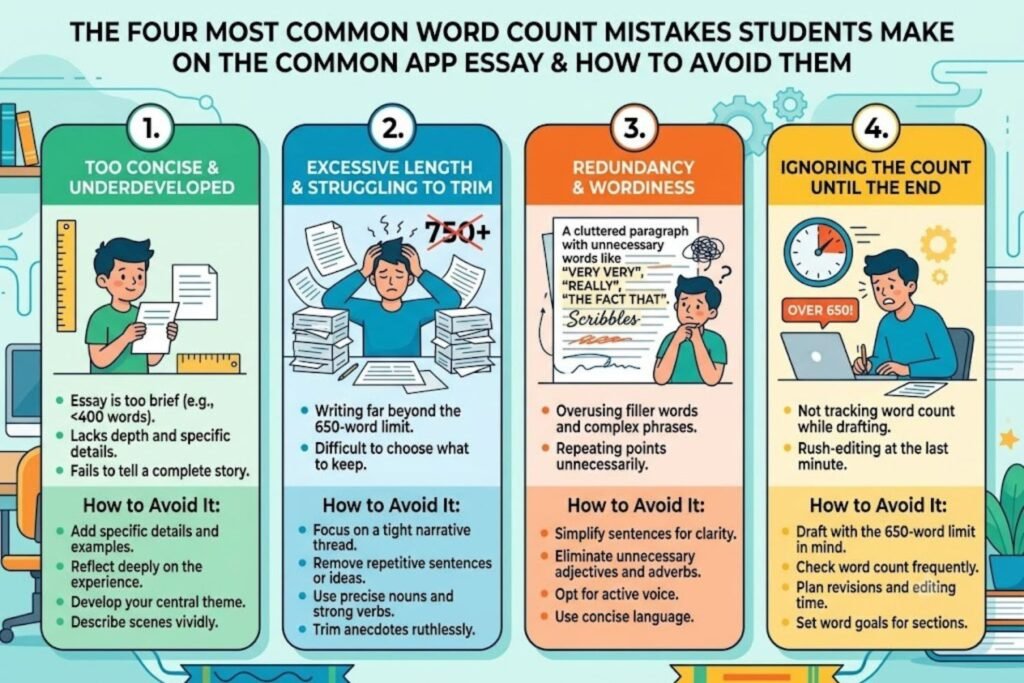
The single most common mistake: stopping short at 450-500 words when you have 650 available.
Why students do this:
- Fear of rambling
- Belief that “brevity is better”
- Running out of ideas (which usually means you haven’t dug deep enough)
The cost: you forfeit the space to develop your story fully and signal incomplete engagement.
Padding With Irrelevant Content
The opposite mistake. Adding filler to hit word count:
- Repeating points
- Including tangential stories that don’t advance your narrative
- Over-explaining concepts the reader already grasps
Padding is immediately visible to experienced readers. It’s worse than coming in short.
Focusing on Someone Else
The single most common mistake is writing about someone else—a grandmother, sibling, coach, or friend—so thoroughly that by the end, the admissions officer has learned far more about that person than about you.
Other people can appear in your essay. But you must be the main character. Every anecdote, reflection, and detail must come back to what you learned, how you changed, or what this reveals about you.
Wasting Words on Explanation
Avoid phrases like:
- “I will discuss my experience with…”
- “The next important thing about my background is…”
- “As I mentioned earlier…”
These are structural announcements that eat words without adding value. Show your story directly. Readers will follow.
How to Reach Your Target Word Count Without Filler
You want 620+ words, but you don’t want to pad. Here’s how to build genuine length.
Write First, Edit Later
Start by writing everything you want to say without watching the word count. Get your story and thoughts out.
Then edit deliberately—cutting weak phrases, adding detail where your story needs it, and deepening reflection.
Most strong essays require multiple passes. First draft often runs long (which is fine). Revision sculpts it into the right shape and length.
Add Specific Details and Sensory Language
Vague: “I worked in a community center, helping kids.”
Specific: “Every Tuesday and Thursday, I arrived at the community center at 3 PM to find Marcus already waiting outside. He’d ask about something from the previous week—a fact about solar flares, a question about why his parents argued. We’d walk to a back room where I’d taught myself enough to keep up with his curiosity, though not always successfully.”
The second version uses more words—but every word earns its place because it creates a vivid, specific picture.
Specificity naturally extends your word count because it requires more words.
Deepen Your Reflection, Don’t Multiply Your Stories
Students often try to hit word count by adding multiple stories: “Here’s experience A. Here’s experience B. Here’s experience C.”
Better approach: pick one compelling core story and develop it fully with multiple layers of reflection.
One story at 620 words is more powerful than three stories at 200 words each.
Use the Editing Audit
After your draft, audit each paragraph:
- Does this paragraph advance the story or add insight? (Keep)
- Does it repeat something you’ve already said? (Cut)
- Is it too vague or general? (Add specific details)
- Is there reflection here? (Strengthen if needed)
This process often adds 50-100 words naturally because you’re deepening existing sections rather than adding filler.
Word Count for Different Common App Prompts
Word count strategy can shift slightly depending on which prompt you choose.
The Topic of Your Choice Prompt
Most flexible. You control entirely what you discuss. Strategy: go 620-650 because you’re writing about something you care deeply about, which should sustain development and reflection.
Personal Growth & Challenge Prompts
“Describe a problem you’d like to solve” or “Recount a challenge and what you learned.”
These prompts demand both narrative and reflection. Use the full range to show both the experience and your thinking about it. Target 620-650.
Identity & Belief Prompts
“Discuss a time you questioned a belief” or “Write about something that defines you.”
These are more introspective. You might naturally use fewer words if your insight is concentrated, but still aim for 580+. Most strong responses to these prompts reach 620+.
Technical Details About the Common App Word Counter
What the System Counts
The Common App counter measures words as strings of characters separated by spaces. The essay body counts—not the prompt or title.
How Hyphenated Words Are Counted
Hyphenated words count as one word. “Self-reflection” = 1 word, not 2. This matters if you use several hyphenated constructions.
Formatting and Spacing
Indentations, line breaks, and extra spacing don’t add to your word count. Only actual words do.
The 650-Word Platform Hard Stop: What Happens If You Go Over
The Cutoff Reality
The 650-word limit is enforced by the Common App platform. Essays exceeding it are cut off mid-sentence.
If you paste a 670-word essay, the admissions officer sees it stop abruptly at word 650, potentially in the middle of a sentence or thought.
How to Avoid Submission Disasters
- Compose in the Common App text box itself (you can see the live word counter)
- Or paste into the Common App and immediately verify the final word count
- Test your submission once before the deadline
- Know that different word processors may count differently, so final verification in the Common App itself is crucial
How Word Count Varies Across Other College Applications
Not all college essays follow the 650-word Common App limit.
Supplemental Essays and Different Word Limits
Individual schools using the Common App often require their own supplemental essays with different word limits. Activities sections use character limits (150 characters each), not word limits. The distinction matters because characters include spaces, punctuation, and letters.
Always verify each school’s specific requirements.
Transfer Application Limits
Transfer applicants face different limits. The Challenges & Circumstances question is limited to 1,250 characters (not words). The Additional Information section is limited to 1,500 characters.
Additional Information Section
The Additional Information section for first-year applicants is limited to 300 words maximum, down from the previous 650.
FAQ: Common App Essay Word Count
1. What’s the exact word count limit for the Common App essay?
The limit is 650 words maximum, with a 250-word minimum, unchanged for 2025-26 and 2026-27.
2. Is a 500-word essay competitive?
A strong 500-word essay can be competitive, but essays landing at 620-650 words demonstrate fuller engagement with the prompt. In competitive admissions, adequate length paired with quality gives you an advantage.
3. What happens if I go over 650 words?
The system cuts off anything exceeding 650 words, and admissions officers see your essay end mid-sentence. This is a submission failure.
4. Do titles count toward the word limit?
No. The word count covers only the essay body, not the prompt you select and not any title you add.
5. Are hyphenated words counted as one or two words?
Hyphenated words count as a single word.
6. Can I paste my essay from Word into Common App and maintain the count?
Generally yes, but word processors may count slightly differently. Always do a final check in the Common App itself before submission.
7. What if my essay is 580 words? Is that acceptable?
Technically yes—you meet the minimum and maximum. Strategically, an essay at 580 leaves available space unused, which admissions officers interpret as incomplete engagement with the prompt. Stronger to push to 600+.
8. Should I aim for exactly 650 words or is 620 enough?
The sweet spot is 620-650 words, not exactly 650 and not below 600. Anywhere in this range signals full engagement.
9. Does eif I write 645 words but feel like I’m padding?
Trust your instinct, but examine honestly: Is each word advancing your story or insight? If yes, it’s not padding—it’s development. If you genuinely can’t justify every word, cut it and accept 600-620.
11. How do I know if my essay is the right length?
Read it aloud. Do you feel like you’ve developed your story fully and reflected meaningfully? Does it feel thin or rushed? Or are you adding filler? Your intuition + feedback from trusted readers matters more than hitting a number.
12. Is there a penalty for submitting below 250 words?
If your essay doesn’t meet the 250-word minimum, you cannot submit through the Common App system.
13. Can I add a subtitle or epigraph without it counting toward the limit?
The Common App doesn’t have a subtitle or epigraph field. Anything you include in the essay text box counts toward your word total (except the prompt itself).
14. Do different prompts have different word count expectations?
No. The word limit is fixed at 650 words, with a 250-word minimum, across all seven prompts. Strategy may shift, but the limit doesn’t.
15. What if I hit exactly 650 words and the platform still won’t submit?
Verify your count in the Common App’s word counter, not in Word. Different processors count differently, especially with formatting.
KEY TAKEAWAYS
- The Hard Rules: 250-word minimum, 650-word maximum for 2025-26 and beyond.
- The Strategic Sweet Spot: Target 620–650 words. Anything below 600 signals incomplete engagement.
- Word Count Signals: Length isn’t arbitrary—it communicates effort, depth, and how seriously you took the assignment.
- Smart Allocation: Structure your essay as opening (100–150 words), development (200–250), reflection (200–250), and closure (50–100).
- Quality Over Pure Length: A tight 600-word essay with strong detail beats a bloated 650-word essay. But a thin 450-word essay loses to a well-developed 630-word essay.
- Specificity Extends Naturally: Concrete details, dialogue, and sensory language naturally extend your word count while improving quality.
- The Cutoff is Real: If you go over 650, the system cuts you off mid-sentence. This is a technical failure, not a style choice.
- Platform Verification Matters: Different word processors count differently. Always verify final count in the Common App itself.
- One Story, Deep: One fully developed story with rich reflection beats three shallow stories.
- The Signal You’re Sending: Essays in the 620–650 range signal that you had enough meaningful material to develop fully. That’s the message admissions officers read.
FINAL CTA
The difference between an adequate essay and a compelling one often isn’t word count—it’s depth. But if you’re undershooting at 500 words when you could be strategically developing your story at 630 words, you’re leaving advantage on the table.
Focus on building a story worth telling in full detail, reflecting meaningfully on what it means, and letting that naturally push you into the 620–650 range. That’s how you use the word count requirement strategically, not mechanically.
Start writing. Aim for detail, honesty, and insight. The word count will follow.