


The telecommunications industry is undergoing a quiet but powerful transformation. In a major policy shift that could reshape the digital landscape, the federal cabinet has approved the launch of telecom services that operate without owning physical network infrastructure. This decision has sparked widespread discussion across the telecom sector and quickly become a major topic in mvno news.
For years, traditional telecom operators have dominated the industry by controlling massive physical infrastructure—cell towers, fiber networks, and spectrum licenses. But the approval of Mobile Virtual Network Operators (MVNOs) opens the door for a new generation of telecom companies that can offer mobile services without building those costly networks.
The move is expected to increase competition, reduce prices for consumers, and encourage innovation in digital services. For businesses, startups, and technology investors, it represents a potentially game-changing development in the global telecom market.
In this article, we break down what this policy means, why governments are supporting MVNOs, and how it could reshape the telecom industry in the coming years.
What Is an MVNO?

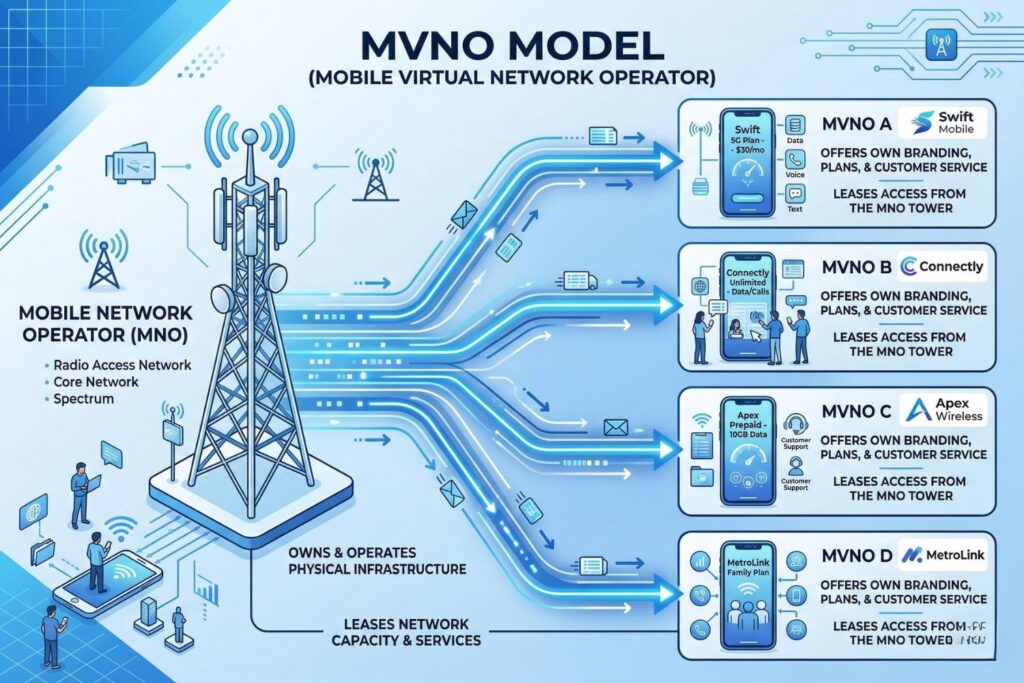
A Mobile Virtual Network Operator (MVNO) is a telecom service provider that offers mobile services such as voice calls, SMS, and data without owning its own network infrastructure.
Instead, MVNOs purchase network capacity from established mobile network operators (MNOs) and then sell services to consumers under their own brand.
How MVNOs Work
- A traditional telecom operator owns the network infrastructure.
- The MVNO leases network capacity from that operator.
- The MVNO sells mobile services to customers using its own pricing, branding, and customer support.
This model allows new companies to enter the telecom market without the billions of dollars required to build physical networks.
Why the Federal Cabinet’s Decision Matters
The approval of telecom services without physical networks marks a significant policy shift. It signals that governments are ready to embrace a more competitive telecom ecosystem.
There are several reasons why this development is making headlines in mvno news:
1. Lower Barriers for New Telecom Companies
Building telecom infrastructure is extremely expensive. Network towers, spectrum licenses, and fiber infrastructure require billions in investment.
By allowing MVNOs, governments enable smaller companies and startups to enter the market with far lower capital requirements.
2. Increased Market Competition
More telecom providers typically mean:
- Lower prices
- Better service quality
- Innovative packages
Consumers could benefit from flexible plans tailored to niche markets such as students, travelers, or businesses.
3. Faster Digital Expansion
MVNOs can accelerate digital connectivity by targeting underserved areas or niche audiences that large operators may overlook.
This can play a major role in expanding mobile broadband adoption.
The Global MVNO Market at a Glance
MVNOs are not a new concept. Many countries already have thriving MVNO ecosystems.
Here is a snapshot of the global MVNO industry:
| Region | Estimated MVNOs | Market Trend |
|---|---|---|
| Europe | 500+ | Mature market with strong competition |
| North America | 130+ | Rapid growth with digital-first brands |
| Asia-Pacific | 100+ | Expanding due to smartphone adoption |
| Latin America | 70+ | Emerging market |
| Middle East & Africa | 40+ | Growing gradually |
The global MVNO market is projected to surpass $100 billion by 2030, according to telecom industry analysts.
This explains why the latest policy change is gaining traction in mvno news discussions worldwide.
How MVNOs Benefit Consumers
One of the biggest advantages of MVNOs is that they bring consumer-friendly innovation.
More Affordable Mobile Plans
Since MVNOs don’t need to maintain expensive infrastructure, they can offer competitive pricing.
Consumers may see:
- Lower monthly bills
- Flexible prepaid plans
- Data-focused packages
Niche Telecom Services
Many MVNOs focus on specific customer segments, including:
- International travelers
- Remote workers
- Students
- Small businesses
Some even offer bundled services such as streaming subscriptions or fintech products.
Better Customer Experience
Digital-first MVNOs often provide:
- Online account management
- App-based support
- Easy SIM or eSIM activation
This modern approach appeals to younger, tech-savvy consumers.
What This Means for Traditional Telecom Operators
While the rise of MVNOs creates opportunities, it also introduces new challenges for traditional telecom companies.
Revenue Sharing Models
Network operators will earn revenue by selling network capacity to MVNOs.
This can create a new income stream without additional infrastructure investment.
Increased Competition
However, MVNOs may compete directly with existing telecom brands.
Operators will need to:
- Improve service quality
- Offer better pricing
- Innovate faster
In many countries, the relationship between MNOs and MVNOs has evolved into a collaborative ecosystem rather than pure competition.
Challenges Facing MVNOs
Despite the opportunities highlighted in mvno news, MVNOs also face several challenges.
Dependence on Network Providers
Since MVNOs rely on existing telecom networks, their performance depends on the host operator.
If network quality is poor, the MVNO’s reputation can suffer.
Thin Profit Margins
Telecom services are highly competitive. MVNOs must manage costs carefully to remain profitable.
Brand Awareness
Entering a market dominated by large telecom brands can be difficult. MVNOs must invest heavily in marketing and customer acquisition.
Industries That May Launch MVNOs
One of the most exciting aspects of the MVNO model is that non-telecom companies can launch mobile services.
Industries that often launch MVNOs include:
- Banks and fintech companies
- Retail chains
- Technology companies
- Media and entertainment brands
These companies can bundle mobile services with their existing products.
For example:
- A bank might offer a mobile plan with financial rewards
- A streaming platform could bundle data packages with subscriptions
This cross-industry innovation is one reason MVNOs continue to dominate mvno news headlines.
The Role of eSIM Technology

The rise of eSIM technology is another factor accelerating MVNO growth.
Unlike traditional SIM cards, eSIMs are embedded directly into devices.
This allows users to switch telecom providers instantly without changing SIM cards.
For MVNOs, this means:
- Faster onboarding
- Lower operational costs
- Fully digital activation
As more smartphones support eSIM, the MVNO market is expected to expand rapidly.
What the Future Holds for the MVNO Industry
Industry experts believe the MVNO sector will continue to grow over the next decade.
Several trends are likely to shape the future:
5G-Enabled MVNO Services
With 5G networks expanding globally, MVNOs may offer specialized services such as:
- IoT connectivity
- Smart city solutions
- Enterprise mobile networks
Digital-Only Telecom Brands
New MVNOs are increasingly launching as app-based telecom companies, eliminating physical stores entirely.
Industry Partnerships
Telecom operators may partner with:
- Tech companies
- Automotive brands
- Financial institutions
These partnerships could create entirely new telecom business models.
FAQ: MVNO News Explained
What does MVNO stand for?
MVNO stands for Mobile Virtual Network Operator, a telecom provider that offers mobile services without owning physical network infrastructure.
Why are governments supporting MVNOs?
Governments encourage MVNOs because they increase competition, lower consumer prices, and accelerate digital connectivity.
Are MVNO services reliable?
Yes. MVNOs use the same network infrastructure as major telecom operators, meaning the network quality is often identical.
Can MVNOs offer 5G services?
Yes. If the host telecom network supports 5G, MVNO providers can also offer 5G mobile services to customers.
Will MVNOs replace traditional telecom companies?
No. MVNOs typically work alongside traditional telecom operators, leasing network capacity rather than replacing them.
Conclusion
The federal cabinet’s decision to allow telecom services without physical networks marks a pivotal moment in the telecom industry. As highlighted in recent mvno news, this move could unlock a wave of innovation, competition, and digital connectivity.
By lowering entry barriers, governments are enabling new telecom players to enter the market and offer creative mobile solutions. Consumers stand to benefit from more choices, better pricing, and improved digital experiences.
While challenges remain, the global success of MVNOs suggests that this model is here to stay. As technology evolves and 5G networks expand, MVNOs could play a crucial role in shaping the future of telecommunications.


