




EU Autos Under Pressure as New Tariff Policies Threaten Europe’s Car Industry
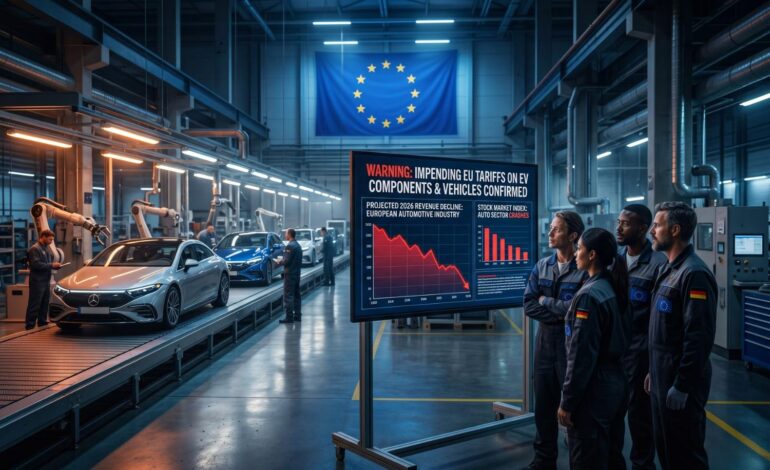

The European automotive sector, often considered one of the pillars of the continent’s industrial strength, is facing fresh uncertainty as new tariff policies begin to reshape global trade relationships. The eu autos market, long recognized for innovation, engineering precision, and premium manufacturing standards, is now under pressure from rising geopolitical tensions and shifting economic strategies.
Across Europe, leading automakers are navigating a difficult landscape marked by increased production costs, tighter environmental regulations, global competition, and now the growing challenge of trade barriers. Industry leaders warn that if tariff pressures continue, Europe’s automotive sector could face slower growth, reduced exports, and significant economic disruption.
For decades, eu autos have represented quality and reliability, with European brands commanding respect in global markets. However, changing trade policies in major markets such as the United States and China are threatening to weaken the competitive edge that European carmakers have built over generations.
Why New Tariff Policies Matter for EU Autos
Tariffs directly affect the cost of imported and exported vehicles. When countries increase import taxes on foreign vehicles, manufacturers either absorb the additional cost or pass it on to consumers through higher prices.
For the eu autos industry, this creates immediate financial strain.
Europe exports millions of vehicles annually to major global markets. These exports contribute significantly to economic growth across countries like Germany, France, Italy, and Spain. Higher tariffs reduce demand by making European-made vehicles more expensive for international buyers.
Automakers are now forced to reconsider pricing strategies, production locations, and future investment plans.
Many analysts believe these tariff measures are not temporary disruptions but part of a broader restructuring of international trade priorities.
This could permanently reshape how eu autos compete globally.
Germany Faces the Biggest Risk
Germany remains Europe’s automotive powerhouse. Major manufacturers such as BMW, Mercedes-Benz, and Volkswagen rely heavily on exports.
A tariff increase targeting European vehicles could have severe consequences for German manufacturing output and employment.
The German automotive sector supports hundreds of thousands of jobs directly and millions indirectly through supply chains, logistics, and technology partnerships.
If export volumes decline significantly, production slowdowns could trigger layoffs and factory restructuring.
The pressure on eu autos is especially intense because German automakers are already investing heavily in electric vehicle transformation.
Balancing EV investment while facing reduced international profitability creates a difficult financial challenge.
Electric Vehicle Transition Adds Complexity
The shift toward electric mobility was already one of the biggest transitions in automotive history.
Now, tariff uncertainty adds another layer of complexity.
European manufacturers have committed billions to EV production, battery technology, and charging infrastructure development. But trade barriers can disrupt critical supply chains for raw materials and battery components.
China dominates battery material processing and electric vehicle manufacturing scale. Tariff tensions involving Chinese imports create cost uncertainty for European EV expansion.
This puts eu autos in a vulnerable position.
Manufacturers must accelerate EV innovation while managing unpredictable international trade restrictions.
Some experts warn this could delay Europe’s clean transportation goals if investment momentum slows.
Supply Chain Disruptions Continue to Hurt
The global automotive industry has not fully recovered from pandemic-era disruptions.
Semiconductor shortages, shipping delays, raw material price volatility, and labor constraints continue affecting production schedules.
Tariff changes add yet another obstacle.
European manufacturers depend on highly interconnected global supply chains. Components often cross multiple borders before final assembly.
Any increase in import duties raises costs throughout the manufacturing process.
For eu autos, this means reduced flexibility and narrower profit margins.
Automakers may respond by relocating parts production closer to assembly plants, but restructuring supply networks takes years and significant capital investment.
Consumers May Pay Higher Prices
When tariffs increase operational costs, consumers often feel the impact.
Higher vehicle prices could reduce demand across both domestic and international markets.
European consumers are already facing inflation pressures, rising interest rates, and increased living costs.
If eu autos become significantly more expensive, buyers may delay purchases or choose lower-cost alternatives from competing manufacturers.
This threatens sales performance for both premium and mid-market brands.
Affordability concerns are particularly serious for electric vehicles, where pricing remains a major adoption barrier despite long-term cost savings.
Competition from Chinese Automakers Intensifies
Chinese car manufacturers are expanding rapidly into Europe with competitively priced electric vehicles.
Brands like BYD, NIO, and XPeng are challenging established European players.
This competitive pressure was already forcing eu autos to innovate faster.
Now, tariff-related instability may weaken Europe’s response.
If European automakers face higher export barriers while Chinese manufacturers continue aggressive pricing and technological advancement, Europe could lose market share both abroad and at home.
Industry experts say the next five years will determine whether eu autos remain dominant or gradually lose ground to emerging competitors.
Political Leaders Debate Trade Strategy
European policymakers are divided on how to respond.
Some support reciprocal tariff measures to protect local industry.
Others warn that escalating trade restrictions could trigger broader economic retaliation.
The debate reflects a deeper strategic question:
Should Europe prioritize industrial protectionism or global trade openness?
Supporters of stronger protections argue eu autos need temporary defense while adapting to EV competition and industrial transformation.
Critics say protectionism risks long-term inefficiency and could isolate Europe from critical international partnerships.
The outcome of this debate will shape the future direction of Europe’s automotive sector.
Investment Confidence Is Being Tested
Investor confidence is essential for automotive innovation.
Factories, EV platforms, battery plants, and software ecosystems require long-term financial commitment.
Tariff uncertainty makes forecasting difficult.
Investors dislike instability.
As concerns rise, some may reduce exposure to eu autos until policy clarity improves.
Lower investment confidence can delay technological progress and weaken Europe’s ability to compete with fast-moving international rivals.
This would create ripple effects across technology, employment, and manufacturing ecosystems.
How Automakers Are Responding
European carmakers are adapting in several ways:
- Expanding local manufacturing in foreign markets
- Accelerating EV software development
- Strengthening battery partnerships
- Reducing supply chain dependence on vulnerable regions
- Lobbying governments for trade stability
These measures aim to protect eu autos from prolonged disruption.
However, adaptation requires time and capital.
Short-term financial pressure remains unavoidable.
Manufacturers that adapt fastest may gain long-term resilience, while slower-moving competitors risk losing relevance.
Could Tariff Policies Backfire Globally?
Trade barriers rarely affect only one side.
If countries impose heavy tariffs on European vehicles, retaliation may follow.
This could reduce market efficiency, increase consumer costs worldwide, and slow automotive innovation.
The global car industry thrives on interconnected manufacturing, shared technology development, and cross-border investment.
Disrupting that ecosystem could hurt everyone involved.
The success of eu autos has historically depended on international cooperation.
A fragmented global market would challenge that model.
The Future of EU Autos
Despite mounting pressure, Europe’s automotive sector remains highly resilient.
Its engineering excellence, premium reputation, and technological expertise remain valuable strengths.
But resilience alone will not guarantee future success.
The eu autos industry must adapt faster than ever before.
Innovation, strategic investment, and smart trade diplomacy will determine whether Europe retains its automotive leadership.
Governments and manufacturers must work together to create stable conditions for growth.
Without coordinated action, tariff uncertainty could become a long-term drag on one of Europe’s most important industries.
The coming years will reveal whether eu autos can successfully navigate this period of transformation—or whether new global competitors will permanently reshape the automotive landscape.
For now, one thing is certain:
The pressure on Europe’s automotive sector is real, and the decisions made today will define the road ahead for decades to come.